
HTML Elements
Posted on December 27, 2015 Leave a Comment
It seems to me that everyone can build a website! Some people build websites better than others; many use outdated technologies or haven’t stayed up to speed with web standards and the latest developments within HTML5 jQuery and the like – but none the less building websites and adding content to the web is easier than ever.
I recently came across this periodic table of valid HTML elements. So if you’re building websites; aren’t sure if the tag you are using is allowed; or just want to explore your knowledge of HTML markup take a look! You never know you might just find a tag that you didn’t know existed and it might solve a problem that has been bugging you for months. Enjoy!
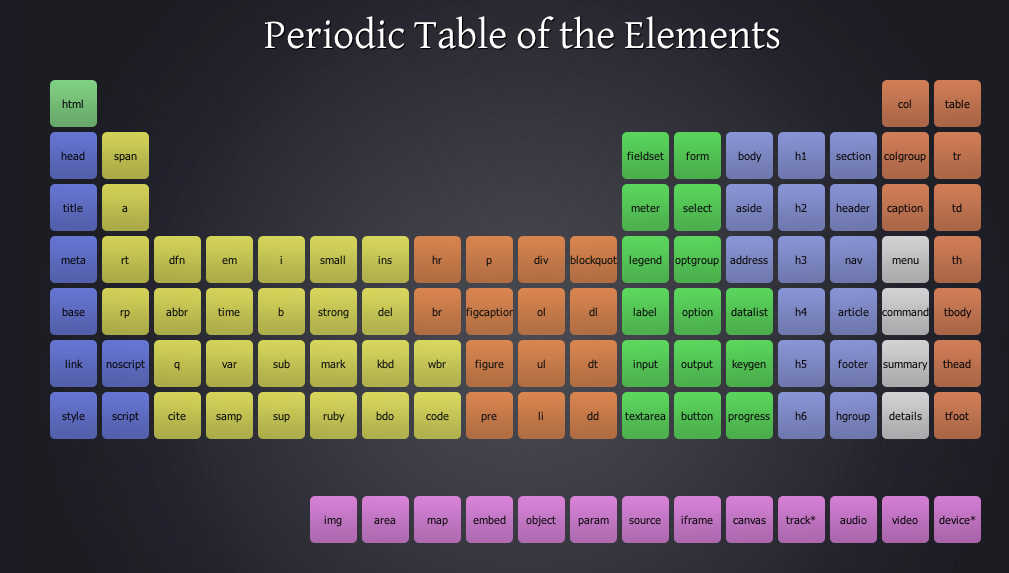
If you want more information on any of the elements check out W3C.
iOSDEVUK – My Favourite Bits!
Posted on September 13, 2015 Leave a Comment
So last week was the fifth @iOSDEVUK and what a brilliant week it was. Its always good to meet up with everyone in Aberystwyth and to share ideas and experience so that as a developer community we can learn to build better apps that surprise and delight our users.
I thought I would do a brief roundup of my highlights of the week and share one or two things that I learnt along the way.
Creating Usable Apps – Maxim Cramer (@mennenia)
This was by far one of my favourite sessions. Maxim looked at how developers should engage users in the development process and how that feedback can be used to improve apps. The session was very hands on and it was great opportunity for us to get some feedback on the new @chestersu app that we’re building and also to input and provide feedback on the Capital One iOS app. Great learning and incredibly useful.
#TopTip, get a user to test your app today – go up to someone in a coffee shop and ask them to do something on your app and watch what they do! Remember to tell the user that we are testing the product though; and not them!
iOS top trick – Chris Ross (@darkrock)
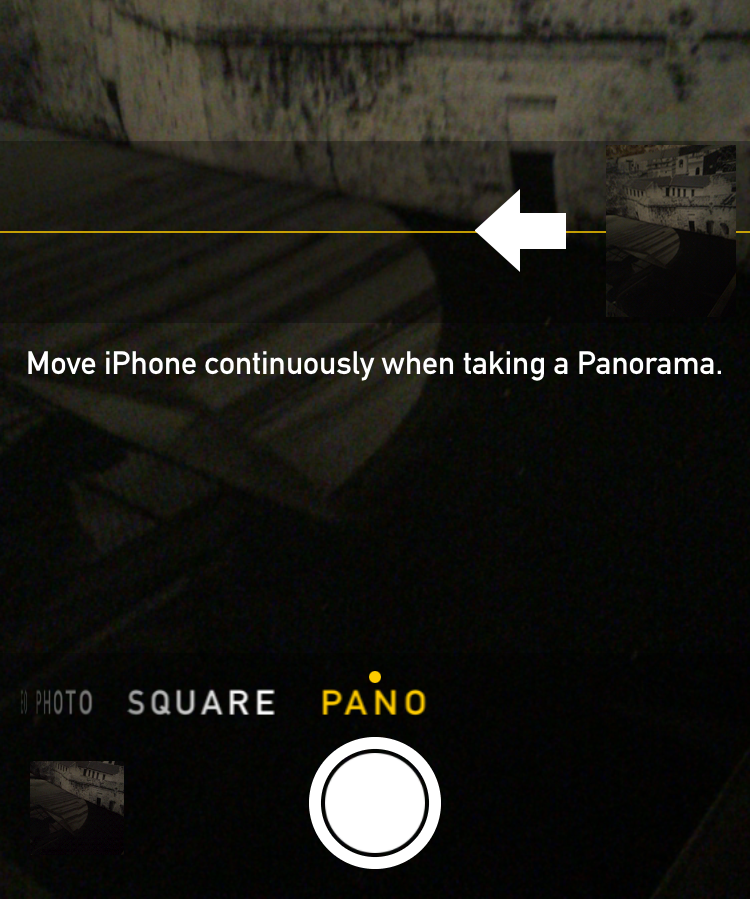
This just goes to show that you can always learn something new about the platform you use everyday. I can’t believe I didn’t know this before Chris featured it in his lightning talk – if use the panorama feature on your iphone you’re used to taking panoramas left to right. Did you know you can take a panorama right to left just by tapping the arrow to change direction?
Doing Mobile at facebook – Simon Whitaker (@s1mn)
I’ve seen Simon talk a number of times and he never fails to disappoint. His talk on facebook explored a whole myriad of things from development practices, how Facebook handles scale and the problems associated with this and not forgetting the fact that the facebook mobile app is over 100Mb because it contains 18000 classes. Brilliant value and great talk!
Selfie Ideas – Chris Wilson (@abitofcode)
Who knew that if you take a selfie through a loo role you would look like the moon! #toptrick and great lesson! #tryit

Magic Transitions – Shawn Welch (@shawnwelch)
This really is useful; the library developed by square allows users to create magic transitions similar to keynote. Once this is open sourced I think we’ll start to see some really cool transition effects coming to iOS apps #cantwait.
Core Data Multithreading – Marcus Zarra (@mzarra)
Marcus is always fantastic value; I’ve seen him talk about core data 3 or 4 times and I always come away having learnt something new. This year the talk was all about multithreading and how it is now possible to create multiple Persistent Store Co-Ordinators across multiple threads. If you need to know more about Core Data read his books! #Brilliant
So that was my favourite moments from @iOSDEVUK – as always I could have written about so much more; from the new friends made at the conference dinner to the annual Rummers reunion that must surely be about to enter mythical legend.
Huge big up to everyone involved with organising the event; can’t wait for next year!
A perplexing keynote
Posted on September 11, 2015 Leave a Comment
So Apple held there September Event on Wednesday and I’ve got to be honest; I’m a little perplexed. If you haven’t seen the keynote you can watch it here
The rumours by en large proved true; the new Apple TV complete with SDK is definitely a welcome addition to the line up; and the iPhone 6s and iPhone 6SPlus isn’t exactly a revelation. I laughed when Tim played the iPhone video as I genuinely believe they could have used the iPhone 6 and iPhone 6 Plus in place of the new devices on screen and no-one would have noticed.
There were 2 things in the keynote though that left me wondering why.
First off; MICROSOFT! What were they doing? I had visions of the Steve Balmer Developers, Developers, Developers moment being repeated – surely Microsoft don’t believe that if Mohammad won’t go to the Mountain then Microsoft must go to the developers?
Its more than that though – I can accept the argument of the two companies “burying the hatchet, and Microsoft not feeling the need to compete; but in allowing Microsoft to present Office on the iPad Apple in my eyes have effectively acknowledged that the Office suite is a superior product to iWork and in some ways have abandoned Pages, Numbers and Keynote.
The second why moment in my view relates to the new Apple Surface …. sorry iPad Pro. That thing is huge and well expensive! I may well come to eat my words, but why would you want to have a tablet that size? For me I’d have preferred them to keep the existing overall size of iPad but introduce a thinner bezel to maximise screen real estate.
Then, there is the Apple Pencil – need I say more than to quote Steve Jobs “If you see a stylus, they have got it wrong” – #notconvinced; that said I’m sure some artists and graphic designers may find it useful, I just don’t believe its right for the mass market.
So there you have it; Apple have gone mad – well maybe not mad, but it strikes me that they are once again struggling to innovate.
I believe they don’t really know what to do next with iPad and are floundering for its next big success. For me they just need to slow down a little; there isn’t a need to have a brand new iPhone every year, and certainly not a brand new iPad – I’m not saying never refresh the product again; just take some time out and then introduce something new and innovative to the market.
Its time for them to take a risk and I fear if they don’t perhaps we are going to see that they have already ridden the crest of the wave and are about to watch the wave break over cupertino and the apple campus.
QR Codes
Posted on June 1, 2015 Leave a Comment
At Footsqueek we have recently been doing a lot of work with QR Codes. We are using them as an educational tool to allow schools to make wall displays much more interactive.
A couple of years ago QR codes seems to be everywhere, on every high street, on business cards, in shop windows, and on membership cards to name but a few. Recently they seem to have been less prevalent and i’m wondering why that is – has the technology been and gone so quickly?
Perhaps people are looking for technologies to make their lives easier – having to reach into your pocket to get your phone to scan something seems easy enough but maybe its viewed as to much effort or to consuming to really make life easier. After all do we really need to see the content that is linked to from the QR code.
I still speak to countless individuals who have no idea what a QR code is or how to use one – on that basis maybe the technology piqued before its time.
That said we still find it useful in an educational context so maybe there are some specific markets – are you using QR codes? How do you use them?
Artificial Intelligence – Can a Robot Ever Be Intelligent?
Posted on May 1, 2015 Leave a Comment
 I was recently reminded of of a Robot developed by Sony a few years ago called QRIO (Quest for Curiosity). The device had some awesome unique features like the ability to recognise people’s faces and the ability to deal with emotional responses such as anger or annoyance. One of the most amazing things about the machine is that it has the ability learn.
It occurs to me though that as intelligent as QRIO may seem, and despite the fact that it can copy and remember behaviour the robot is not truly intelligent because it doesn’t have the ability to make independent decisions – it simply does what it is programmed to do. We must therefore consider what we really mean when referring to an intelligent technology and question if technology can ever be truly intelligent.
Aristotle said:
There is only one condition in which we can imagine managers not needing subordinates, and masters not needing slaves. This would be if every machine could work by itself, at the word of command or by intelligent anticipation.
It is possible for programmes to be written that can emulate intelligent anticipation. An example would be a Central Heating system that can be programmed to maintain a certain temperature within a set environment. The system anticipates when the consumer is likely to want to turn the heating on, responds to the environmental change and performs the task.
This is not, however, true intelligent anticipation because the system only reacts when a set of pre-programmed conditions are evaluated as true. To be intelligent the system would have to decide what the required temperature was without any human intervention.
It occurs to me that even if such a system were technically possible consumers would react negatively as the concept comes close to the Big Brother totalitarian state described by Orwell in his Novel Nineteen Eighty Four.
Darwin’s theory of Evolution demonstrates that the human race has evolved into an intelligent species, embracing inteligence to survive; it could be argued that truly inteligent systems are the next stage of human evolution and could be used as a self protection mechanism to assist our survival.
Until technology enables this evolutionary shift we much resign ourselves to devising methods of control for automated systems that make working with technology more convenient for the consumer, while recognising that sometimes a task does not require automation because the consumer is content with the current solution, or because society is not yet ready to embrace the long term possibilities or consequences.
If you want to find out more about QRIO check out these links:
Rules on the golf coarse
Posted on May 24, 2014 Leave a Comment

I’ve recently started having golf lessons and I’m really enjoying it! I’ve been really surprised by how quickly I’m learning the sport and how quickly I’ve been able to see visible improvement.
As a result I’m spending more time at the golf coarse; something which is taking a little getting used to is the quirks of golf etiquette – “no trainers in the club house”, “no mobile phones on the fairway”. No one tells you these rules unless you break then – hence the fact that I’m now eating breakfast outside in my trainers – in fairness it’s warm enough but it has made me consider whether sometimes rules for the sake of rules becomes annoying.
It reminds me of a great online community started by a friend of mine, Andy Clark, while at university. “Stick it to the man” was all about breaking seemingly pointless rules that could never really be enforced and in reality didn’t matter “No Walking on the Grass”, “No standing on the bus”, “No birds”. Some of the photos are really inventive and you can still find it on twitter @stickit2_theman. Hope you enjoy 🙂
 WestgarthsWeb